

IPTC AI Breakthrough: Decoding Persuasion in Digital Advertising
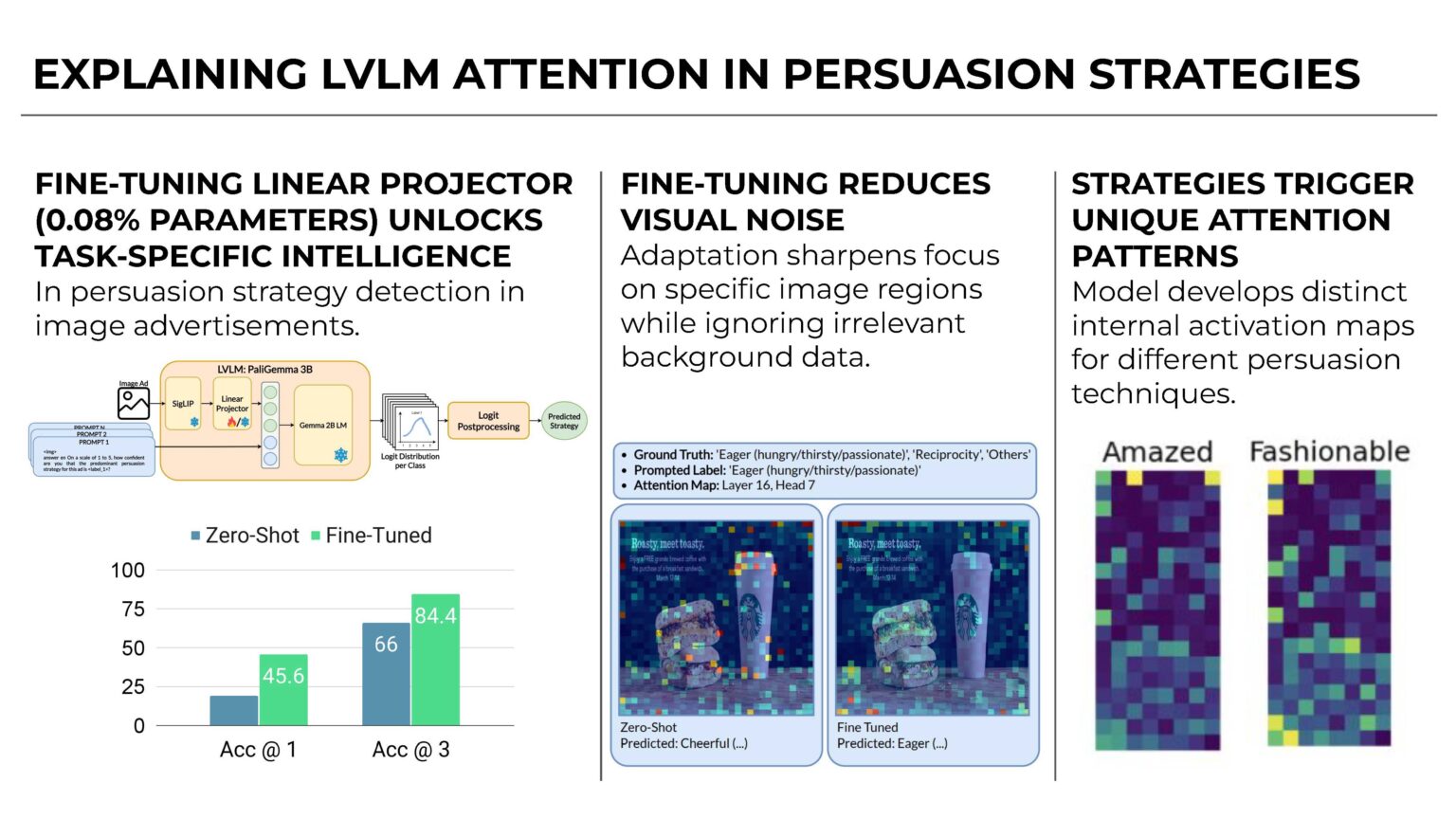
Researchers from the Information Processing and Telecommunications Center (IPTC) at the Universidad Politécnica de Madrid (UPM) have achieved a significant milestone in AI explainability. Their study focuses on how Large Vision-Language Models (LVLMs), specifically PaliGemma, can be adapted to identify 16 complex persuasion strategies in advertisements—such as authority, scarcity, and emotional appeal.
By implementing a lightweight fine-tuning of the model’s linear projector (affecting only 0.08% of its parameters), the IPTC team increased the model’s accuracy from 19.6% to 66.0%. Beyond performance, the research provides a deep dive into “attention explainability.” The study reveals that after adaptation, the AI’s “visual focus” becomes significantly sharper and more task-specific, effectively filtering out background noise to concentrate on the elements that trigger human persuasion.
Potential Applications:
- Ethical Advertising & Regulation: Automated tools to audit marketing campaigns, ensuring compliance with consumer protection laws and ethical standards.
- Neuromarketing & Consumer Behavior: Enhancing the ability to predict how complex visual stimuli influences human decision-making and emotional responses.
- Explainable AI (XAI): Developing more transparent AI systems that can justify their “reasoning” when processing subjective human perceptions in real-world media.
This work was carried out in collaboration with the AI Multimedia Lab at the University Politehnica of Bucharest (UPB). The partnership reflects a shared commitment to advancing research in multimedia understanding and explainable artificial intelligence, combining the expertise of IPTC (UPM) with the international research efforts of the AI Multimedia Lab to further explore how AI systems interpret and explain persuasive visual content in digital media.
Bibliographic reference:
Martín-Fernández, I., Constantin, M.G., Ionescu, B., Esteban-Romero, S., Fernández-Martínez, F., Gil-Martín, M. (2026). A Case Study on Large Visual-Language Model Attention Explainability After Adaptation Using Persuasion Strategies in Advertisements. In: Lokoč, J., et al. MultiMedia Modeling. MMM 2026. Lecture Notes in Computer Science, 16412, pp. 103 -116. https://doi.org/10.1007/978-981-95-6950-2_8
Iván Martín Fernández: GS / ORCID / LinkedIn
Sergio Esteban Romero: GS / ORCID / LinkedIn
Fernando Fernández Martínez: GS / ORCID / LinkedIn
Manuel Gil Martín: GS / ORCID / LinkedIn
LinkedIn: https://www.linkedin.com/company/iptc-upm/
For more information: www.iptc.upm.es
Share this: