
Federated Synthetic Data for Survival Modeling
Researchers from the Information Processing and Telecommunications Center (IPTC) at Universidad Politécnica de Madrid (UPM) have developed a novel framework that significantly improves survival analysis in healthcare scenarios characterized by data scarcity, heterogeneity, and strict privacy constraints.
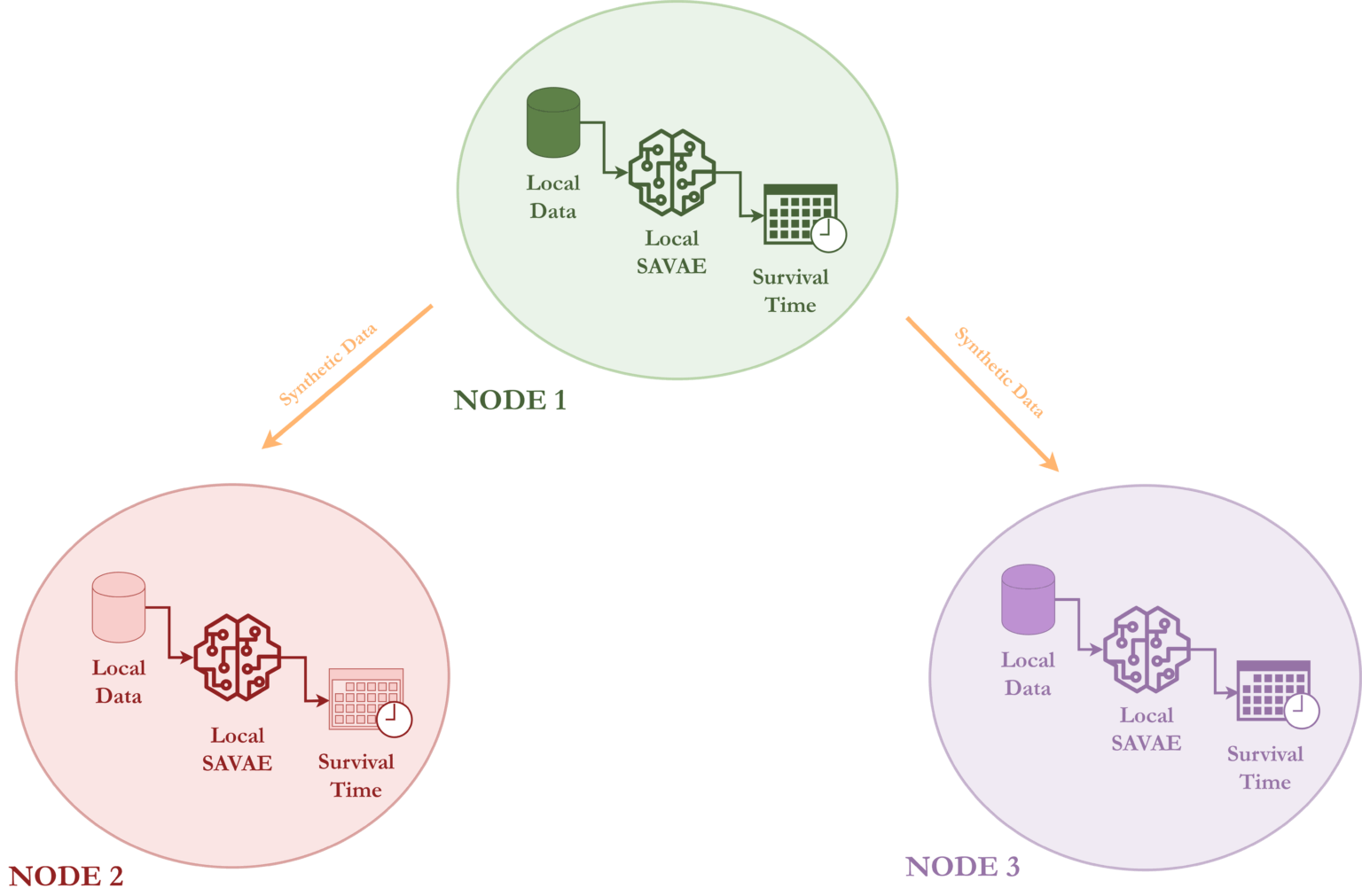
The proposed method, called Federated Synthetic Data Sharing (FedSDS), integrates synthetic data generation with federated learning to enable collaborative model training without sharing raw patient data. Instead of exchanging model parameters, as in traditional approaches such as Federated Averaging, FedSDS generates high-quality synthetic datasets locally using advanced generative models (SAVAE and VAE-BGM) and shares them across institutions in a single communication round.
A key innovation of the framework is a biased aggregation strategy, which filters synthetic samples in latent space to ensure alignment with each institution’s local data distribution. This approach proves especially effective in non-IID (non-identically distributed) and low-data settings, where classical federated learning methods often struggle. Extensive experiments on real-world clinical datasets demonstrate that FedSDS consistently improves predictive performance, particularly in the most disadvantaged nodes with limited or biased data.
By reducing communication overhead, preserving privacy, and enhancing robustness under heterogeneous conditions, FedSDS provides a scalable and practical solution for decentralized survival modeling.
Potential Applications
- Multi-center oncology research
- Rare disease prognosis modeling
- Privacy-preserving hospital collaboration
- Personalized medicine in distributed healthcare systems
- Federated analytics in regulatory-constrained environments
Bibliographic reference:
Apéllaniz, P., Parras, J. & Zazo, S. Enhancing survival analysis through federated learning in non-IID and scarce data scenarios. Computers in Biology and Medicine, 204 (2026), pp. 111558. https://doi.org/10.1016/j.compbiomed.2026.111558
Patricia Apéllaniz: GS / ORCID / LinkedIn
Juan Parras: GS / ORCID / LinkedIn
LinkedIn: https://www.linkedin.com/company/iptc-upm/
For more information: www.iptc.upm.es
Share this: