

AI for Movement-Based Anomaly Detection
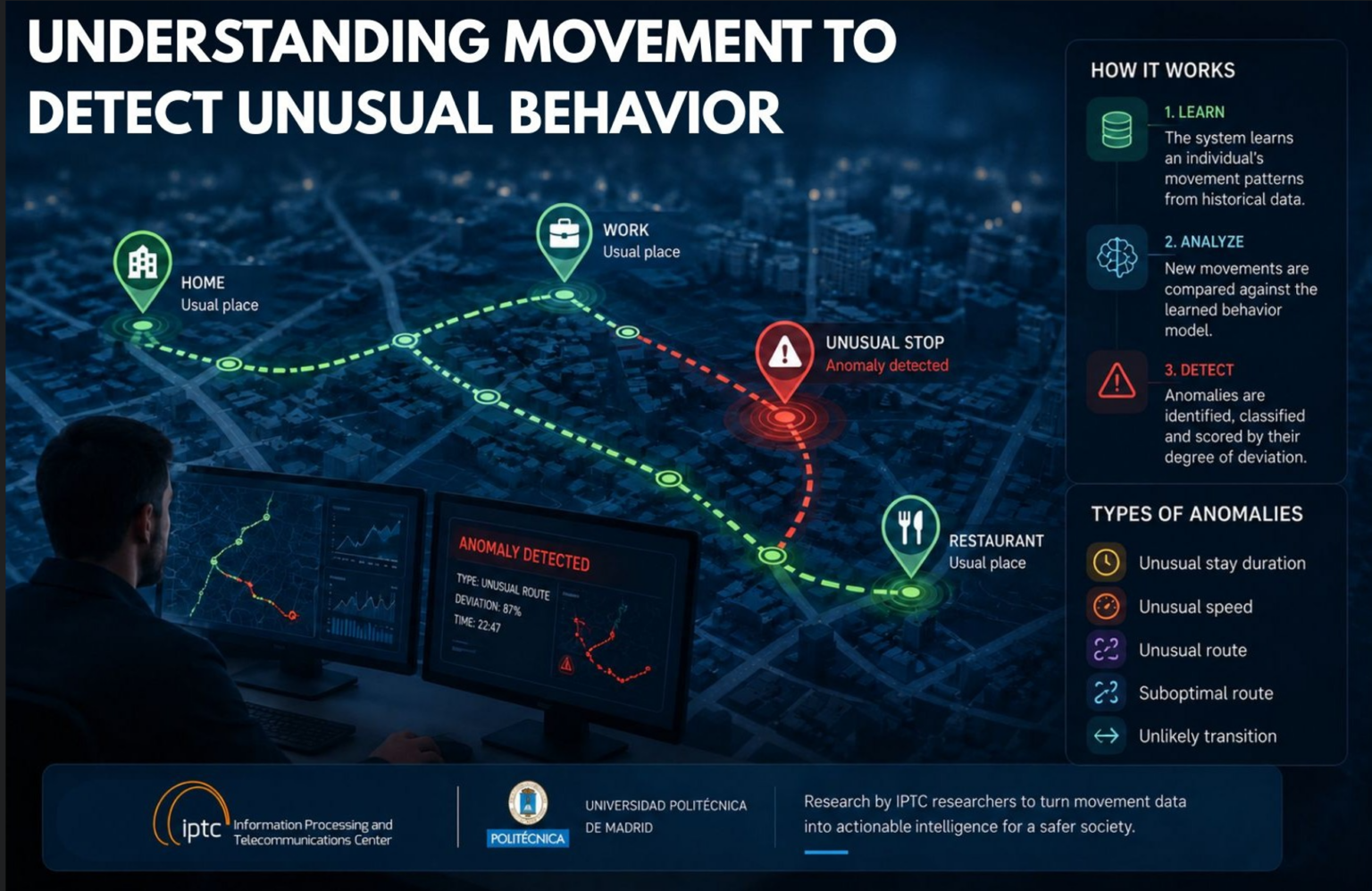
Researchers from the Information Processing and Telecommunications Center (IPTC) at the Universidad Politécnica de Madrid (UPM) have developed an innovative system that models human movement patterns and detects anomalous behaviors using georeferenced location data. The forensic analysis of location data is a common yet resource-intensive task in criminal investigations, often with high computational and time-related costs to identify relevant movement patterns. Their work, presented at the 2026 IEEE International Conference on Intelligent Environments (IE 2026) introduces a robust framework designed to support security and investigation scenarios by automatically identifying suspicious movement patterns.
The proposed system combines an enhanced Time- and Distance-Based Clustering (TDBC) algorithm with statistical inference techniques to build behavioral models from historical GPS trajectories. By identifying meaningful points of interest (POIs) and learning regular movement habits—such as stay duration, travel speed, preferred routes, and visit sequences—the system establishes a baseline of expected behavior. New trajectories are then compared against this model to detect and classify different types of anomalies, while also estimating their degree of deviation.
The researchers validated the approach using a synthetic police investigation scenario involving suspected drug trafficking. Results demonstrate that the proposed clustering method outperforms conventional algorithms under moderate and high-frequency sampling conditions, while the anomaly detection framework achieves high accuracy, particularly when sufficient historical data are available.
Beyond law enforcement, this research opens the door to a wide range of applications. The methodology could support smart city security, critical infrastructure protection, border surveillance, and transportation monitoring, as well as help detect unusual mobility patterns in emergency response or public safety operations. Future developments aim to extend the system with additional behavioral models and graph-based deep learning techniques to improve performance in real-world environments.
The IPTC also warmly congratulates the paper’s first author, Lorena Quesada Ilmert, who received the IE26′ Beatrice Worsley Award for the referenced paper during IE 2026, the 22nd International Conference on Intelligent Environments, where the work was presented.
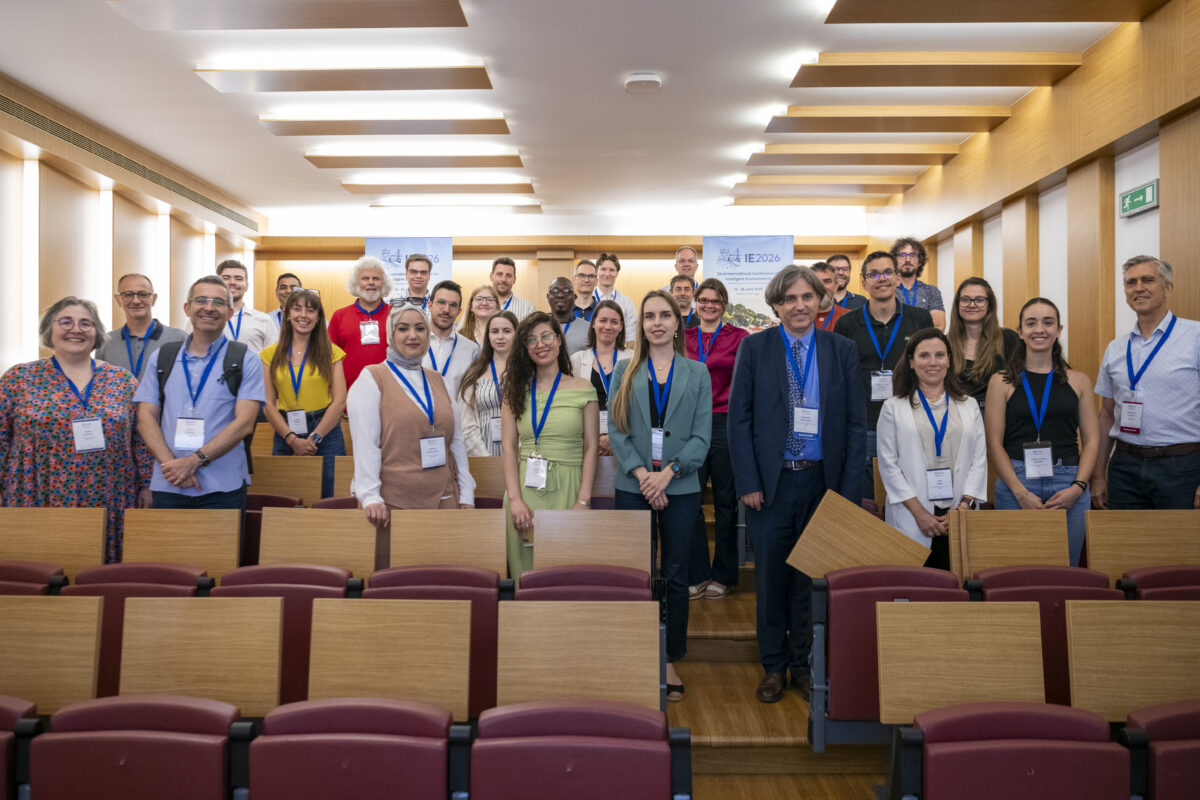
This prestigious recognition highlights the scientific quality and impact of her research and represents a well-deserved achievement for this outstanding young researcher.
Congratulations, Lorena, on this remarkable accomplishment!
Bibliographic reference:
Ilmert, L., Bernardos, A.M. & Casar, J.R. A System for Movement-Based Behavior Modeling and Anomaly Detection in Security Contexts in 22nd International Conference on Intelligent Environments (IE), Lisbon, Portugal, pp. 1-8. Conference paper. https://doi.org/10.1109/IE69249.2026.11539026
Lorena Quesada Ilmert: GS / ORCID / LinkedIn
Ana María Bernardos Barbolla: GS / ORCID / LinkedIn
José Ramón Casar Corredera: GS / ORCID / LinkedIn
LinkedIn: https://www.linkedin.com/company/iptc-upm/
For more information: www.iptc.upm.es
Share this: